It's been a while since I've posted on this blog, but that doesn't mean I've been slacking on my Japanese studies. I did struggle a bit with the curriculum that I made for myself, so I revamped it (again).
Right now I'm using a few useful resources for studying, including my SRS, Anki. I recently discovered a "wikibooks" page for the JLPT (Japanese Language Proficiency Test) Grammar points, so I'm taking notes and throwing example sentences into Anki.
I'm also just starting out with the "Nihongo sou matome" series to study kanji, vocabulary, grammar, reading, and listening.
Now for the big update: I'm applying to study abroad in Japan for the 2016-2017 school year. I had one meeting today, and I have another one in a couple days before applications open up on November 1. I'll have more info on this soon, but if things go well, I'll be returning to Japan for the third year in a row, and I'll be able to stay for more than two months this time around.
That's what I'm going to leave you with, so until next time...
Take care!
Adam
アダム

Showing posts with label Studying Japanese. Show all posts
Showing posts with label Studying Japanese. Show all posts
Monday, October 12, 2015

Monday, August 31, 2015
A New Attitude: Back to Studying Japanese
I've been home from Japan for about a week now, and I have been setting time aside to do some Japanese studying just about every day. I returned to Anki with fresh, new decks since I unfortunately lost all of my old ones.
Right now, I'm flying through the N5 Vocab deck, and I'm working on the Jalup Beginner 1000 again. I feel like I should be way further along than this, but I don't mind having a refresher after not having a chance to actually "study" for a few months. I will say, however, that my listening ability improved quite a bit while I was in Japan, and it's especially noticeable when I'm listening to music.
Anyway, what's new about my attitude this time, you ask? This is going to sound crazy, but previous times that I've studied Japanese, I was so dedicated that I would study for 3-4 hours a day and eventually burn out. I wouldn't give myself days off, and my Anki reviews were "everything."
So... my attitude is much more relaxed now. I'll study on the days that I can, and yes, I know this can be a dangerous mindset, but if I'm too serious, I'll burn out and quit again. It'll work out alright, and now I have friends that are motivating me to study Japanese more.
But for now, I want to study and not write this post.
See ya!
Adam
アダム
Right now, I'm flying through the N5 Vocab deck, and I'm working on the Jalup Beginner 1000 again. I feel like I should be way further along than this, but I don't mind having a refresher after not having a chance to actually "study" for a few months. I will say, however, that my listening ability improved quite a bit while I was in Japan, and it's especially noticeable when I'm listening to music.
Anyway, what's new about my attitude this time, you ask? This is going to sound crazy, but previous times that I've studied Japanese, I was so dedicated that I would study for 3-4 hours a day and eventually burn out. I wouldn't give myself days off, and my Anki reviews were "everything."
So... my attitude is much more relaxed now. I'll study on the days that I can, and yes, I know this can be a dangerous mindset, but if I'm too serious, I'll burn out and quit again. It'll work out alright, and now I have friends that are motivating me to study Japanese more.
But for now, I want to study and not write this post.
See ya!
Adam
アダム
Wednesday, January 28, 2015
Slow Down Before You Burn Out
It’s nice that you can work at your own pace when you’re
studying Japanese (or any subject) on your own.
It makes it a lot easier to accomplish greatness sooner than if you were
to take a class on your subject of choice.
However, there is a risk involved, and that risk is
burnout. I studied Japanese intensely on
a couple of occasions, and when I couldn’t keep up the pace, I quit altogether.
Now I’ve been back at it for almost a month, and every day I’ve
been learning 25 kanji characters, 25 vocabulary words, and 25 sentences. This is great and all, and I feel like I learned
a lot, but now my reviews are piling up every day. I used to have all of my studying done by
noon, and now it’s later in the evening when I finally finish my routine.
I can feel it: exhaustion.
I’ve had this feeling a couple of times before, and both times I gave up
on my favorite hobby. I’m not going to
let that happen again, so today I made the decision to learn 15 new kanji
characters, 15 words, and 15 sentences instead of 25.
I’ll probably retain the information better, and it’ll make
my reviews easier. I don’t know if I’ll
go at this pace permanently, but I need to take a little break to catch my
breath without going cold turkey. I’m
going to continue studying every day, but now that I’m four weeks into college
classes and I have scholarship essays to write, I need to slow down the Japanese
pace a bit.
Until next time,
Adam
アダム
Sunday, January 11, 2015
The Ideal Japanese Study Routine
Hey everyone, I have been following the Jalup (Japanese Level Up) curriculum of Japanese studying for just under two weeks now, and I have to say that I'm already seeing incredible results. I just wanted to share what I've been doing during the first two weeks to give you a few ideas of what to expect if you follow this method.
 First of all, you'll need to download Anki, a spaced repetition flashcard program that really does work wonders for your brain. If you don't know how it works, the first time you see a new flashcard, you'll see it 10 minutes later, then the next day if you get it right, then 3-4 days from then, and then 6-7 days later, etc. It tries to move the information from your short-term memory to your long-term memory over time, and I vouch for this program completely.
 Now then... I'm using three decks inside of Anki. The first deck series is the Jalup Beginner 1,000 sentence deck. It costs $24.99 for each stage of 250 sentences, but the information in the sentences is invaluable and definitely worth it.

 The second deck is Japanese Level Up's RTK mod. Basically, James Heisig's "Remembering the Kanji" series teaches over 3,000 kanji characters, but not all of them are necessary to learn. The RTK mod eliminates the unnecessary kanji and leaves you with 1,901 characters to master. Since I learned the 2,200 characters in the first book back in 2012, I'm breezing through this stage of Japanese studying.

 And the last deck that I'm using isn't actually used in the Japanese Level Up program, but I find it incredibly useful. A while ago, I subscribed to iKnow's Core series that taught the 6,000 most used Japanese words. The Anki deck called "Core10Kv4" teaches the 6,000 words in the Core 6,000 series plus roughly 4,000 additional words. Example sentences and audio from native speakers is included with every word, so expect this deck to take a while to download. I should also mention that the Jalup decks also have native audio for every sentence.
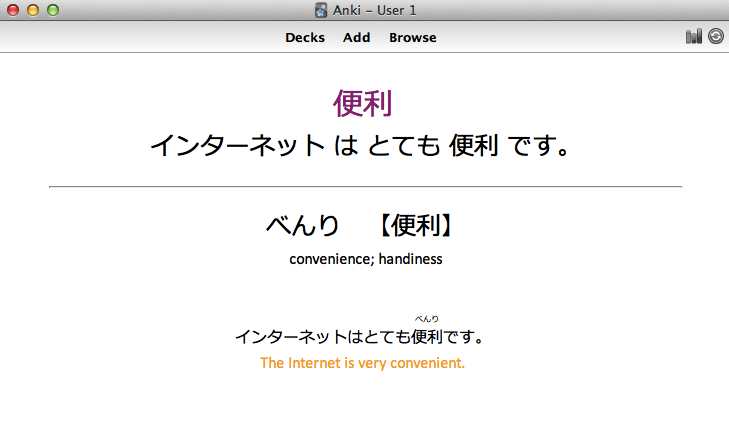
Now then... I'm using three decks inside of Anki. The first deck series is the Jalup Beginner 1,000 sentence deck. It costs $24.99 for each stage of 250 sentences, but the information in the sentences is invaluable and definitely worth it.The second deck is Japanese Level Up's RTK mod. Basically, James Heisig's "Remembering the Kanji" series teaches over 3,000 kanji characters, but not all of them are necessary to learn. The RTK mod eliminates the unnecessary kanji and leaves you with 1,901 characters to master. Since I learned the 2,200 characters in the first book back in 2012, I'm breezing through this stage of Japanese studying.And the last deck that I'm using isn't actually used in the Japanese Level Up program, but I find it incredibly useful. A while ago, I subscribed to iKnow's Core series that taught the 6,000 most used Japanese words. The Anki deck called "Core10Kv4" teaches the 6,000 words in the Core 6,000 series plus roughly 4,000 additional words. Example sentences and audio from native speakers is included with every word, so expect this deck to take a while to download. I should also mention that the Jalup decks also have native audio for every sentence.
So in the past 13 days, I have brushed up on roughly 375 kanji, 375 sentences, and 375 vocabulary words. Breaking up my daily studying into three different categories (kanji, sentences, and vocab) makes it easier to learn or relearn about 25-50 flashcards from each category every day. And then if I want to study more on any given day, I'll just research Japanese culture and history or take a look at the Dictionary of Basic Japanese Grammar for a few extra pointers.
What do you think of this Japanese studying routine? What do you do when you study Japanese or any subject for that matter? Don't hesitate to leave a comment below.
Later,
Adam
アダム
Monday, January 5, 2015
The Journey Until Now - Part 2 (Tackling Kanji in 2012)
2012 was a big year for me. It marked the end of my high school career and the beginning of college. But what did I do with my summer break between these two life milestones? I decided to start learning Japanese again, so I picked up James Heisig's book "Remembering the Kanji" and started learning the English definitions of 2,200 characters over the course of about 45 days.
How the heck is this even possible?
Well, to be fair, I didn't learn how to read these characters, and they were taught in order of simplicity, not by frequency. So the character for bird (鳥) didn't show up until towards the end of the book because of its complexity. And to give you another example, I learned the characters for tree, grove, and forest all together. It makes sense once you see what they look like: 木、林、森
And then in the same lesson, I learned how to write oak tree (柏), which uses the characters for tree (木) and white (白). White was taught in a previous lesson.
What I'm trying to say is that for the most part, new characters had some sense of familiarity by breaking characters up into manageable chunks or "elements."
So... spending about four hours a day studying these characters made it possible for me to learn them all in under two months. I'd wake up by 6 or 7 in the morning, make some hot chocolate (because I hate coffee) and sit down at the kitchen table with my kanji book and my computer. Kanji Koohii was a really useful site when I was learning these characters because a community of people studying the same way shared their stories for how they memorized them. For instance, a lot of people turned the kanji for person (人) into Mr. T, but I decided to call it Dwight Schrute in my stories.
And then I came up with a story for "cook" which includes the kanji for fire (火) and lack (欠). So here's my story: Those who set the kitchen on fire lack the skills to cook. It's simple, but it worked, and I had hundreds of little stories like this... some that aren't necessarily "blog appropriate."
What I'm trying to say (in a roundabout way) is that learning the kanji characters was fun for me. But then college started, and I quit reviewing them. And when I stopped reviewing, I forgot how to write a lot of the characters.
Yes, this post is also ending at a point where I took a break from studying Japanese again. But if you're interested in more about my Japanese learning journey, my trip to Japan as an American counselor at summer camps, or anything related to Japan, feel free to follow this blog and add me to your circles on Google+.
Until next time,
Adam
アダム
How the heck is this even possible?
Well, to be fair, I didn't learn how to read these characters, and they were taught in order of simplicity, not by frequency. So the character for bird (鳥) didn't show up until towards the end of the book because of its complexity. And to give you another example, I learned the characters for tree, grove, and forest all together. It makes sense once you see what they look like: 木、林、森
And then in the same lesson, I learned how to write oak tree (柏), which uses the characters for tree (木) and white (白). White was taught in a previous lesson.
What I'm trying to say is that for the most part, new characters had some sense of familiarity by breaking characters up into manageable chunks or "elements."
So... spending about four hours a day studying these characters made it possible for me to learn them all in under two months. I'd wake up by 6 or 7 in the morning, make some hot chocolate (because I hate coffee) and sit down at the kitchen table with my kanji book and my computer. Kanji Koohii was a really useful site when I was learning these characters because a community of people studying the same way shared their stories for how they memorized them. For instance, a lot of people turned the kanji for person (人) into Mr. T, but I decided to call it Dwight Schrute in my stories.
And then I came up with a story for "cook" which includes the kanji for fire (火) and lack (欠). So here's my story: Those who set the kitchen on fire lack the skills to cook. It's simple, but it worked, and I had hundreds of little stories like this... some that aren't necessarily "blog appropriate."
What I'm trying to say (in a roundabout way) is that learning the kanji characters was fun for me. But then college started, and I quit reviewing them. And when I stopped reviewing, I forgot how to write a lot of the characters.
Yes, this post is also ending at a point where I took a break from studying Japanese again. But if you're interested in more about my Japanese learning journey, my trip to Japan as an American counselor at summer camps, or anything related to Japan, feel free to follow this blog and add me to your circles on Google+.
Until next time,
Adam
アダム
Sunday, January 4, 2015
The Journey Until Now - Part 1 (Human Japanese in 2011)
April 2011 (junior year of high school)
"Eh, I don't feel like studying French anymore... Why can't they offer languages that would be really impressive to learn?"
Looking at Japanese text intimidated me, but at the same time, I thought "How cool would it be to be able to read this? I bet I could impress the ladies... or maybe just my friends."
And then I thought about it further. I've been a fan of Nintendo since I was a kid, and the Japanese culture seemed interesting to me. It was definitely something that I was willing to research more.
So what did I do? I hopped onto YouTube, searched "how to write in Japanese" and I found Japanesepod101.com's series Kantan Kana. I used this series to learn the two basic writing systems, ひらがな (Hiragana) and カタカナ (katakana). I started out at a slow pace, learning about five characters a day. At the time, I wasn't sure how much time I wanted to devote to this "project" yet. All I knew was that I had nothing to do after school, and I wanted to see if I could learn a language with my free time.
And then I stumbled across the goldmine of learning software. And no, it's not Rosetta Stone.
Human Japanese
 This software is a godsend. I'm not just saying that, either. The time that I spent with Human Japanese was the most valuable time that I spent learning how to read sentences (in Kana) and listen to native speakers say the sentences whenever I click on them. That's right, my friends. Every sentence in Human Japanese has an audio file attached to it. You don't need to insert a disc and find the track. It's right there with the sentence.
 Yes, Human Japanese does introduce hiragana and katakana characters, so you could easily skip the YouTube series that I used and jump right into Human Japanese. However, I found the beginning chapters slightly easier since I already attained basic reading skills.
When I finished Human Japanese, the Intermediate version wasn't available at the time, so I bought textbooks. There's no need for me to mention the names, but I can tell you that studying wasn't as fun anymore. Also, a lot of the material in the books was already covered in Human Japanese, but I didn't feel like I was ready for the Intermediate textbooks.
So what did I do? I decided to take a break from the project that brought me so much joy... all because I was lost and unsure about what to study next. Keep in mind that I was coming up with my own curriculum. I didn't have teachers to help me out, and none of my friends shared an interest in learning Japanese. I was too shy to try conversing with native speakers in Japanese, so I put the books away and invested time in video games.
That's where this post comes to an end, I'm afraid. But 2012 was right around the corner. A new year meant new opportunities, and that's what I'm going to leave you with for today.
Until next time,
Adam
アダム
Subscribe to:
Posts (Atom)